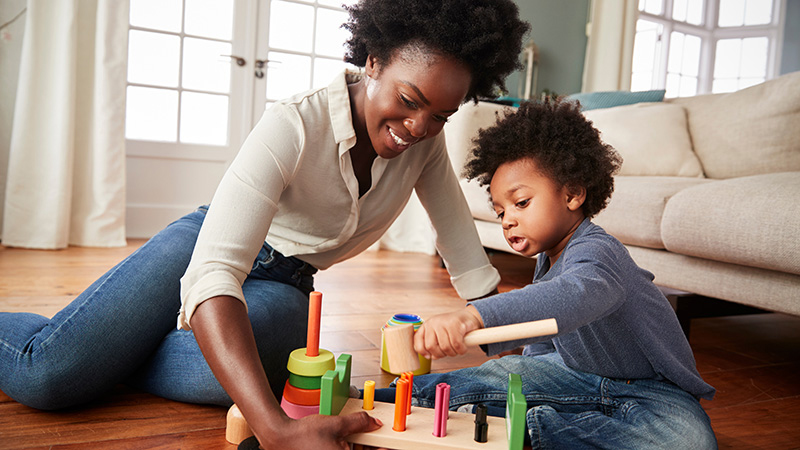

Joint attention. This is a term you may have heard in reference to your child’s development. But, what is it really?
What is joint attention?
Joint attention is simply the shared focus of two individuals (i.e. you and your child) on the same object of interest. This can happen when one individual alerts their communication partner to an object, usually through eye gaze and pointing. For example, you and your child are outside. You then see an airplane flying in the sky. You initiate joint attention by pointing and looking at the airplane saying “Look! An airplane!” hoping that your child will follow your gaze and point and also attend to that airplane.
Why is joint attention important?
Children on the autism spectrum often have difficulty both following joint attention and initiating this interaction with their caregivers or peers. Overall, joint attention is crucial for developing your child’s communication. It also helps develop important social skills such as bonding and seeing another’s point of view.
How to increase joint attention.
Here are some ways you can work on increasing your child’s joint attention skills:
1. Be a language model.
Use gestures (i.e. pointing) along with eye gaze to show your child where you want them to look with you. A good place to start is using hand over hand teaching to help your child point to objects. You can also practice with objects or toys your child really likes.
2. Follow your child’s lead.
If your child is showing interest in a toy, you can comment “You like the bubbles!”, add a gesture by pointing to the bubbles, and then add a visual cue (point to your eyes and pretend to draw a line from your eyes to the object).
3. Incorporate your child’s routines.
One of the best ways for your child to practice joint attention is through the routines they have every day at home! This can be during brushing teeth, bath time, and eating a snack. For example, during snack time, give your child small pieces of their snack and wait for them to look at you and/or point to what they want before giving them another piece.
Bloom Behavioral Solutions in autism treatment, crisis management, communicative disorders, and feeding/eating intervention. For information on our treatment services, please feel free to contact us.
By: Lauren Billingsley, M.A., CCC-SLP
As a child, Ms. Genevieve loved Just so Stories” by Rudyard Kipling. The stories are allegories for how things are formed like the alphabet, or how a leopard gets its spots.
Since becoming a mother, Ms. Genevieve’s new favorite, and one she hopes to pass down through her own family, is You Belong Here by M.H. Clark. The book talks about how the stars belong in the sky, and the whales belong in the sea. The illustrations are great as it gives parents a chance to teach not only to identify items (receptive language skills) and beings in nature, but also prepositions (e.g. the stars are above the sea). The ending talks about how a child belongs with their family, something that hits the heart of any parent and child; along with sweet illustrations to foster the familial bond.
Kory earned her Masters Degree in Science and Health with specialization in Nutrition and Dietetics from the University of North Florida. Kory has a total of 10 years experience working as a Registered Dietitian.
She first worked in an outpatient clinic where she worked with all ages from infants to the elderly. She currently works at a local hospital where she devotes her time to nutrition support and educating patients, staff and the community. Since Kory has started working for Bloom Behavioral Solutions, Inc., she has found passion in the challenge of offering ways to improve nutrition in children and families. Kory lives at the beach and enjoys all the beach has to offer. In addition, she loves to spend time with her family, exercise, run and cook. Kory is on a mission to improve the health and wellness of all ages one bite at a time.