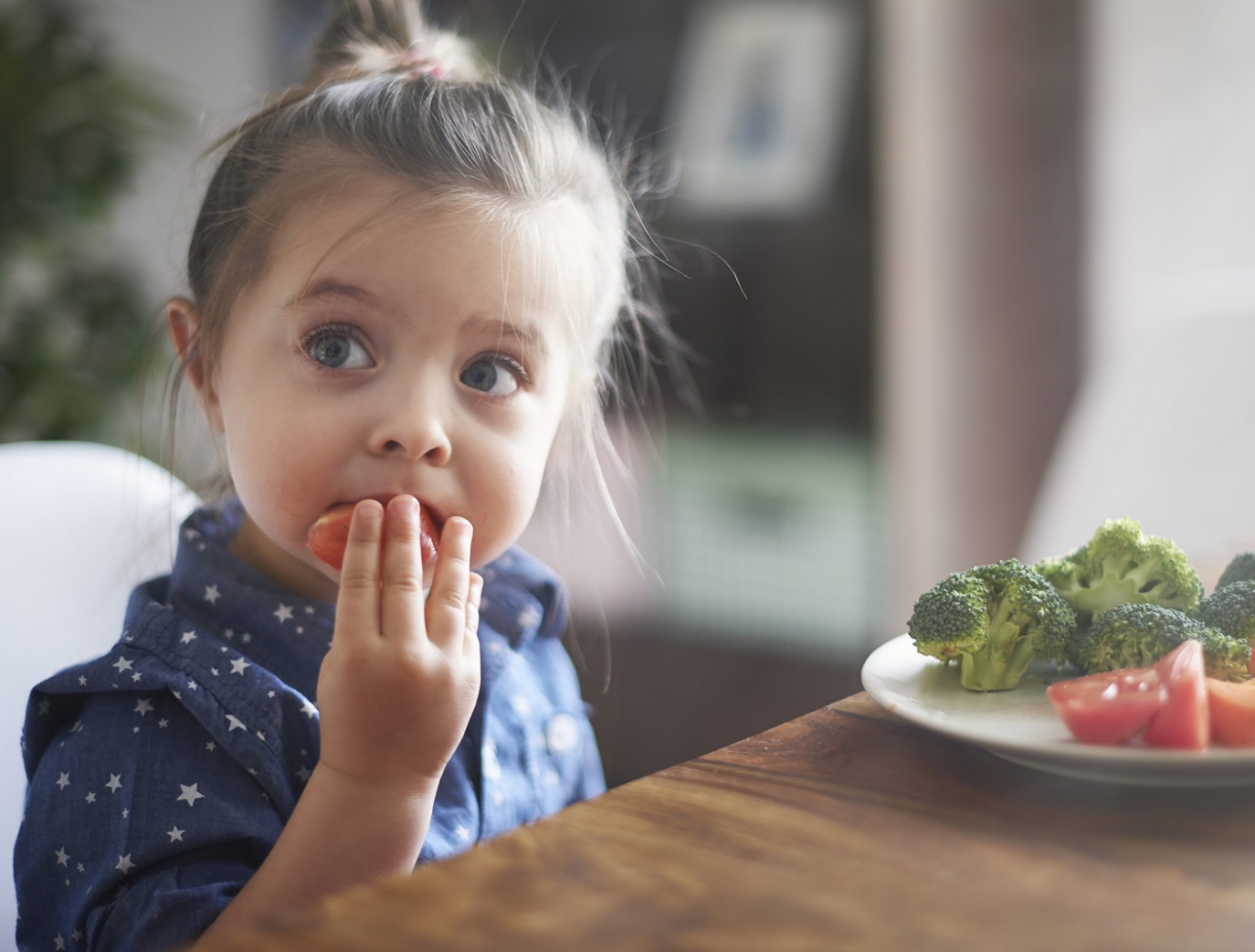

Selective or “picky” eating (PE) often plagues families with small(ish) children.
Mealtimes can wreak havoc on parents and have them wanting to avoid mealtimes with their kids. As a parent myself of two toddlers, I am well versed in what is deemed “yucky”. My three-year-old son can dig his way the center of the earth in mud, but a small change in the way a food item looks is “yucky”; and even an absurd thought to imagine he would try it. A homemade blueberry muffin that does NOT resemble his mini beloved Publix muffins, can NOT actually taste good! My three-year-old daughter can eat her weight in string cheese, but this version of mozzarella that she asks for daily is NOT the same as shredded mozzarella. In fact, if there is cheese in her treasured salads, hell hath no fury!
Young children are very irrational thinkers and explorers. Nope definitely can’t wear the Spiderman shirt I’ve been wearing for weeks, that’s ridiculous to even consider! However, I will take this button I found and see how far it can go up my nose. Such ridiculous rules of thought can be humorous at times, even endearing. However, when it comes to their basic nutritional needs to survive, it can be a daunting and very frustrating argument to have with a young child. In this article I will discuss some helpful tips and simple control techniques to implement in the home setting.
Mealtimes should be a well-established routine. This does NOT mean a specific time of day, although that can be helpful to reduce over-snacking (more on that next month). There should be some format of a “warning” that a mealtime is approaching. This is important because mealtimes typically disrupt a preferred activity like playing outside, or watching T.V. When we’re given a warning that something is going to happen soon, it helps us mentally prepare. The countdown can be something as simple as a verbal notice, a kitchen timer, or a visual timer is always helpful for children with developmental delays.
The next step is to ensure you are enforcing the mealtime. This means if you must chase and physically bring your child to the table then that is simply how it must be. This is not forever, just until there is established parental stimulus control with mealtimes. Plus your fitbit will be happy you did all that chasing!
It’s important that each family member has the same contents on their plates. They do not have to eat each item, but it’s important to establish the idea that what mommy or daddy eats is not just for grown-ups. Often parents will make two meals, one for the kids and one for the adults. Not only is this a giant pain for caregivers, but it teaches that certain foods are designated for certain eaters.
There should be a No Thank You plate or bowl. This is designed to teach them that they don’t have to like everything, but they can’t speak negatively (emotion words like “yucky”) about food, throw it, feed to the dog, etc. They must “respect the plate”. This dish serves as the container where undesired consumables go to live out their lives before being packed up with the remaining leftovers.
The No Thank You dish also requires the child to interact with the food. Physical interaction with a consumable is frequently the first step prior to oral placement. The No Thank You dish is not going to be a permanent fixture on the table, just until your little eaters have an established routine and develop a more adventurous palate.
When does the mealtime end? The mealtime should end when all participants are satiated. Consuming a specified quantity should NOT signal it’s time for dessert. This can lessen the volume of nutritious intake. For instance, when a child is informed that they can have ice cream after they finish their asparagus, it signals them to stop at a certain point visually. Asparagus gone=end of meal=ice cream. If they are told that the mealtime is over after the family and guests are also finished, it allows them more time to consume what’s on their plates and develop better mealtime manners. Bargaining can also unintentionally create a reinforcement valence. We never want to suggest that eating something healthy is not a fun and enjoyable experience. If a child is used to having a treat after a meal, it’s a good idea to shape this routine into something more appropriate. Try stating something like “yes we do have brownies, but we’re going to eat them later not right after dinner”.
The final tip is to end a mealtime with having the children assist in cleanup. This is not only helpful for caregivers, but it helps to establish the finality of mealtimes. I find that my own children really find this as an amusing family affair. They really enjoy being able to pack up leftovers, place dishes in the dishwasher and wipe off the table.
Bonus tip- When creating a new mealtime routine, it can be very helpful if you start in a different setting. Take mealtime outside! This time of year is perfect for outdoor dining. Eating outdoors and establishing the new mealtime routine can easily be transferred when resuming indoor dining. Mealtimes outdoors doesn’t have to be a repeated affair. It easily can take just one time to set the new expectations.
I hope you enjoyed these tips and tricks, and enjoy happier and healthier mealtimes with your families!
By: Genevieve Covington, M.A., BCBA
Founder & Feeding Intervention Specialist

Joint attention. This is a term you may have heard in reference to your child’s development. But, what is it really?
What is joint attention?
Joint attention is simply the shared focus of two individuals (i.e. you and your child) on the same object of interest. This can happen when one individual alerts their communication partner to an object, usually through eye gaze and pointing. For example, you and your child are outside. You then see an airplane flying in the sky. You initiate joint attention by pointing and looking at the airplane saying “Look! An airplane!” hoping that your child will follow your gaze and point and also attend to that airplane.
Why is joint attention important?
Children on the autism spectrum often have difficulty both following joint attention and initiating this interaction with their caregivers or peers. Overall, joint attention is crucial for developing your child’s communication. It also helps develop important social skills such as bonding and seeing another’s point of view.
How to increase joint attention.
Here are some ways you can work on increasing your child’s joint attention skills:
1. Be a language model.
Use gestures (i.e. pointing) along with eye gaze to show your child where you want them to look with you. A good place to start is using hand over hand teaching to help your child point to objects. You can also practice with objects or toys your child really likes.
2. Follow your child’s lead.
If your child is showing interest in a toy, you can comment “You like the bubbles!”, add a gesture by pointing to the bubbles, and then add a visual cue (point to your eyes and pretend to draw a line from your eyes to the object).
3. Incorporate your child’s routines.
One of the best ways for your child to practice joint attention is through the routines they have every day at home! This can be during brushing teeth, bath time, and eating a snack. For example, during snack time, give your child small pieces of their snack and wait for them to look at you and/or point to what they want before giving them another piece.
Bloom Behavioral Solutions in autism treatment, crisis management, communicative disorders, and feeding/eating intervention. For information on our treatment services, please feel free to contact us.
By: Lauren Billingsley, M.A., CCC-SLP

As our kiddos grow and develop their gross and fine motor skills, one thing to look at is pencil grasp development.
As mentioned before, our bodies develop big to small or proximal to distal, and that also applies the same for grasp development. Maturing our grasp patterns depend on stability and strength in our large muscles which help encourage and develop precision and control in our small muscles that is needed for picking up and stabilizing objects.
The Stages of Grasp Development
When discussing the progression of grasp development, the first stage, or grasp pattern, a child might demonstrate is called the palmar supinate or whole hand grasp. This grasp pattern is encouraged in our toddlers while learning to scribble on paper.
Once more control is gained, our kiddos begin to demonstrate a digital pronated grasp, also known as palmar grasp, where the index finger and thumb point down, the pencil is held in the middle of the hand and the elbow slightly sticks out. Usually around the age of 3-4, the grasp pattern begins to mature, noticing more movement in the wrist for control to form pre-writing shapes, tracing and coloring.
Lastly, the tripod grasp, which includes the thumb, index and middle fingers with the pencil laying in the web space (between thumb and index finger). This grasp promotes more finger mobility allowing for more skilled movement patterns one uses for handwriting, precision coloring and motor control.
Here’s How to Increase Your Child’s Pencil Grasp Development:
- Activities that promote a tripod grasp can be developed through play activities and don’t always have to involve the use of a pencil.
- Here are a few ideas that can be done at home:
- Threading beads or cereal onto a string, pipe cleaner or dried spaghetti noodles.
- Painting with a q- tip, small sponge or cotton balls using water colors
- Play with tongs or tweezers picking up or placing (placing beads in play-dough and then removing with tongs is a favorite of mine)
- Breaking the crayons in half promote the kiddo to use thumb, index and middle finger to grasp and color.
- Squirt and spray bottles require you to activate the index and middle finger while stabilizing with your thumb.
Bloom Behavioral Solutions in autism treatment, crisis management, communicative disorders, and feeding/eating intervention. For information on our treatment services, please feel free to contact us.
By: Natalie McHale, A.S., COTA

One of the key ways parents can engage more actively with their child is through following along with what they are interested in.
This could be cars, numbers and letters, or bubbles. Research has demonstrated that when we use preferred toys and activities, a child is more likely to communicate, whether that be with PECS, sign language, or vocalizations. Following your child’s lead also means that if they move on to a different toy or activity, you go with them!
Below are some tips and tricks for using this strategy during play activities at home:
1. Narrate your child’s actions.
One way to provide language models is to narrate everything that your child is doing when they are engaging with their favorite toy or activity. This lets your child know that you are interested in what they are doing. It is also a great way to provide continuous language input.
2. Get face to face.
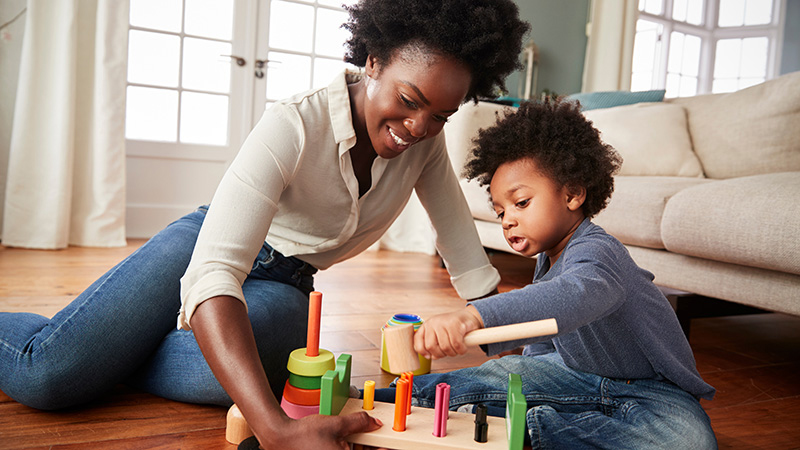
If your child is playing on the floor, get down there with them! Sit across from them so they can see your face as you engage with them in their preferred activity. This way you can model gestures and facial expressions in addition to verbal language.
3. Copy them.
Another way you can engage with your child during play is to copy whatever they are doing with a toy. If they are pushing cars off the table, you push them off too with sound effects! If your child is popping bubbles, you pop them too while saying “pop!”. This is also a great opportunity to attempt taking turns.
4. Provide prompts.
If your child is playing with their favorite toy or engaged in an activity they enjoy, they may be more likely to communicate with you. Provide prompts for them to communicate as much as possible, while still keeping it fun. This could look like saying “ready, set…” and then waiting a few seconds to see if your child will say “go!”.
Bloom Behavioral Solutions in autism treatment, crisis management, communicative disorders, and feeding/eating intervention. For information on our treatment services, please feel free to contact us.
By: Lauren Billingsley, M.A., CCC-SLP
Gross motor skills are a vital part of a child’s development, as the rule of thumb states “gross motor before fine motor”. Nurturing the need for gross motor activities help our kids feel confident in their bodies and whole body movement activities.
What are gross motor skills?
Activities involving the whole body or our larger muscle groups provide confidence during physical activity and help build a foundation for more refined skills such as fine motor throughout development. Encouraging these larger movement patterns promote success and enrich activities in school, home, and on the playground.
Gross motor or whole body movement patterns involve our large muscle groups of the trunk, arms and legs and assist us in everyday activities such as eating breakfast, showering, or tying your shoes. These larger muscle groups must work together with our brain to promote functional movement, balance, coordination, body awareness and strength just to name a few.
Activities to help develop gross motor skills.
Now that we’ve broken down the definition of gross motor or whole body movement patterns and how the larger muscle groups help us make smaller movement, it’s time to talk about activities that promote these movements. Rain or shine, these muscle groups can be enriched inside or outside with endless possibilities and a little imagination.
Activities that promote gross motor development include but are not limited to:
- Crawling
- Jumping
- Climbing
- Dancing
- Playing hopscotch
- Building obstacle courses
- Swimming
- Martial arts
- Riding bikes
- Yoga
- Playing twister
- Balloon volleyball
- Bean bag toss
- Pushing or pulling a wagon or laundry basket
These are just some ways to activate our larger muscle groups and provide confidence in movement.
Bloom Behavioral Solutions in autism treatment, crisis management, communicative disorders, and feeding/eating intervention. For information on our treatment services, please feel free to contact us.
By: Natalie McHale, A.S., COTA
Modeling language is one strategy you can use at home to help your child learn and acquire expressive language. Modeling is saying or doing what you would like your child to do in a certain communicative or play situation.
When providing verbal models for your child, avoid using words like “say” and utilize more naturalistic models of the words you want to hear. Below are some different ideas for how you can incorporate modeling into activities at home.
Model names and actions during play.
During play, you can model the names and actions your child is doing. For example, when playing with bubbles you can say “blow” when blowing bubbles and “pop” and “wow” when the bubbles are in the air. You can also model “bubble” as a one-word request for your child. Model car noises such as “vroom” and “beep beep” when playing with cars and various animal noises when playing with a farm set.
Model asking for help.
You can also model appropriately making requests for assistance. If your child needs help opening a toy or accessing something, you can model the word “open” or “open please”. If they need help with a task such as opening a door that’s stuck or reaching something too high, you can model words like “help”.
Model gestures.
Modeling gestures is another way you can provide communicative examples for your child. During play activities you can model clapping your hands when you are excited or during the song “when you’re happy and you know it”. Modeling hand motions during “itsy bitsy spider” and “wheels on the bus” is another great way to gain your child’s attention during the songs. In order to gain their attention, you can model pointing to objects in your environment that you want to share with your child to get their attention.
By: Lauren Billingsley, M.A., CCC-SLP
As a child, Ms. Genevieve loved Just so Stories” by Rudyard Kipling. The stories are allegories for how things are formed like the alphabet, or how a leopard gets its spots.
Since becoming a mother, Ms. Genevieve’s new favorite, and one she hopes to pass down through her own family, is You Belong Here by M.H. Clark. The book talks about how the stars belong in the sky, and the whales belong in the sea. The illustrations are great as it gives parents a chance to teach not only to identify items (receptive language skills) and beings in nature, but also prepositions (e.g. the stars are above the sea). The ending talks about how a child belongs with their family, something that hits the heart of any parent and child; along with sweet illustrations to foster the familial bond.
Kory earned her Masters Degree in Science and Health with specialization in Nutrition and Dietetics from the University of North Florida. Kory has a total of 10 years experience working as a Registered Dietitian.
She first worked in an outpatient clinic where she worked with all ages from infants to the elderly. She currently works at a local hospital where she devotes her time to nutrition support and educating patients, staff and the community. Since Kory has started working for Bloom Behavioral Solutions, Inc., she has found passion in the challenge of offering ways to improve nutrition in children and families. Kory lives at the beach and enjoys all the beach has to offer. In addition, she loves to spend time with her family, exercise, run and cook. Kory is on a mission to improve the health and wellness of all ages one bite at a time.